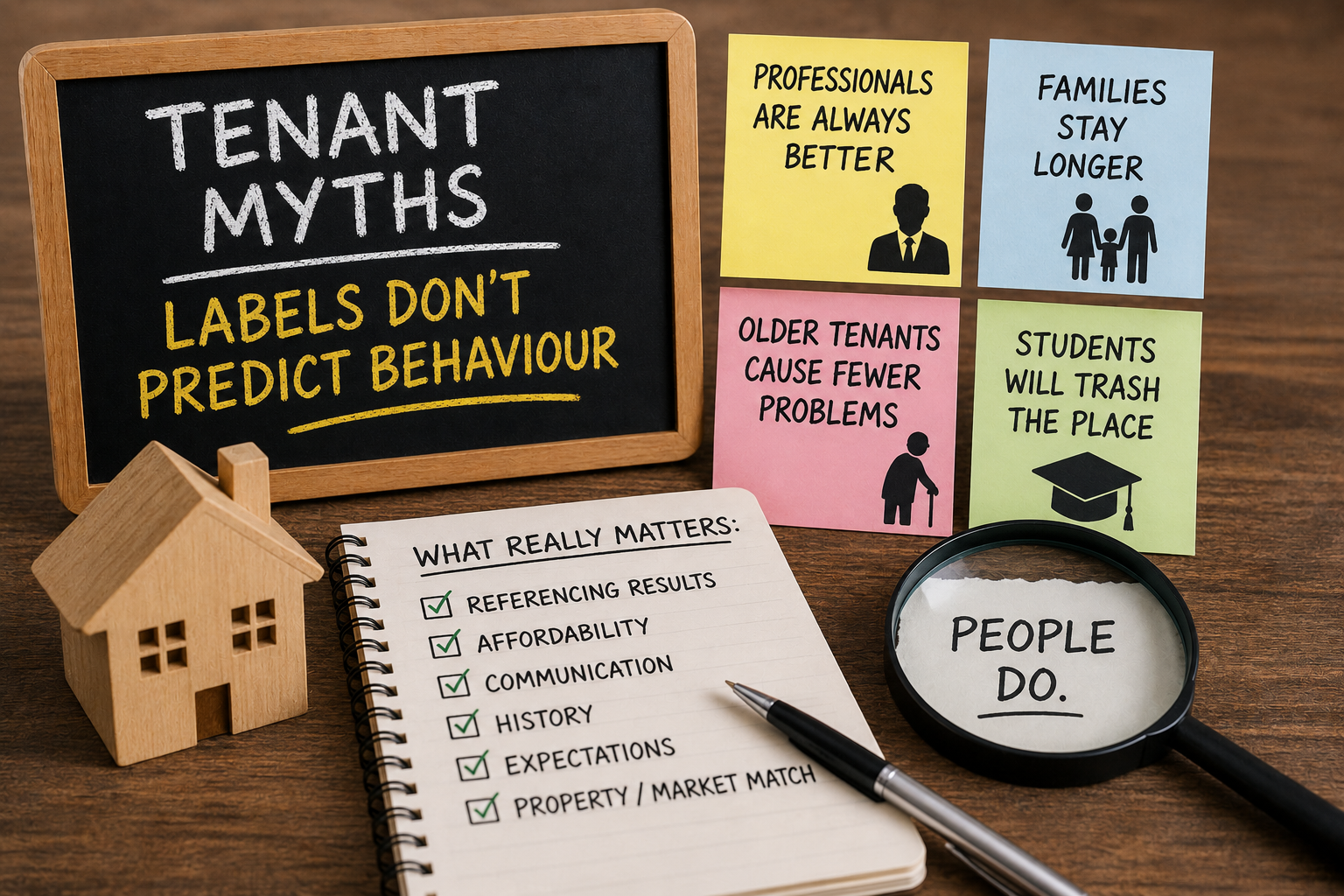
Most property investors have at least one tenant theory.
Usually delivered with total confidence and zero data.
“Professionals are better than benefits tenants.”
“Families stay longer.”
“Older tenants cause fewer problems.”
“Students will trash the place.”
You’ll see comments like this all over social media.
Sometimes these are true. Sometimes they’re nonsense. Often they’re half-true in a way that gets you into trouble if you rely on them.
The uncomfortable reality is this:
Tenant labels don’t predict behaviour.
People do.
The “professional tenant” myth
Professional tenants can be great.
They often have stable income, can pass referencing, and understand the basics of renting.
But “professional” doesn’t mean “easy”.
In fact, some of the most stressful tenancies can involve people with good jobs, good income, and very strong views about what they’re entitled to.
If something breaks, they might not shrug and wait. They might escalate quickly. They might quote legislation. They might go straight to the council. They might threaten legal action.
Not because they’re bad people, but because they’re confident, time-poor, and expect service levels.
So the myth isn’t that professionals are terrible.
It’s that professionals are automatically low-maintenance.
They aren’t.
The “benefits tenant” myth
This one gets messy because people mix up financial reality with stereotypes.
Yes, there can be extra admin. Yes, income structure is different. Yes, you need to understand how payments work and what evidence you need.
But plenty of benefits tenants are stable, long-term renters who treat the property well and stay for years.
They may value security and consistency more than the average tenant who can move easily for work.
Again, the label doesn’t tell you if someone will be a good tenant.
It tells you what sort of checks and set-up you need.
What actually predicts a good tenancy
Here’s what tends to matter more than someone’s job title:
- referencing results, real ones, not “they seem nice”
- affordability, and whether it stacks up after bills
- communication: are they organised, responsive, transparent?
- history: previous landlord reference, stability, red flags
- expectations: do they understand the property and the agreement?
The best tenants aren’t always the richest.
They’re the most reasonable.
The worst tenants aren’t always broke.
They’re the ones who cause chaos.
The real skill: matching property type to tenant type
A lot of tenant problems aren’t tenant problems.
They’re mismatch problems.
Example:
- a one-bed flat in a town where demand is mainly for two-beds
- a family house marketed to transient tenants
- a cheap and cheerful property pitched at people expecting luxury finishes
- a property with no parking in an area where everyone drives
If the property doesn’t match what local tenants want, you get:
- longer voids
- more complaints
- more turnover
- more wear and tear
- more stress
Not because tenants are unreasonable, but because you’ve bought the wrong product for the market.
Set expectations early and your life gets easier
A huge amount of friction comes from unclear expectations.
So get boring and explicit:
- what you handle and how quickly
- what counts as an emergency
- how repairs are reported
- what the tenant is responsible for
- what standards you expect on cleanliness and reporting issues early
This isn’t about being strict.
It’s about being clear.
A good tenant usually appreciates clarity.
A bad tenant usually hates it.
Useful filter.
Don’t let the internet choose your tenants
One of the easiest ways to make bad decisions in property is to outsource your thinking to online narratives.
Tenant stereotypes are everywhere because they’re emotionally satisfying. They make the world feel simpler.
But investing isn’t about feeling clever.
It’s about being right more often than you’re wrong.
So instead of thinking in labels, think in process:
- do consistent checks
- choose based on evidence
- keep standards clear
- and remember you’re running a business, not a social experiment
The practical takeaway
If you want fewer problems, stop trying to predict the future based on labels.
Choose tenants based on:
- solid referencing
- affordability
- behaviour and communication
- and whether the property matches the local market
That approach isn’t exciting.
But it works.
This isn’t advice, of course. Just a reminder that assumptions are expensive — and no one, least of all your lender, is doing you any favours.
Here’s to successful property investing.

Peter Jones
Author, property investor and ex-Chartered Surveyor
 PS. By the way, if you’d like a deeper dive into property investing based on the real-life experience of an investor who has built a substantial multi-property portfolio, my popular e-book, The Successful Property Investor’s Strategy Workshop, explains how I built my own portfolio from scratch and the principles that can help you do the same.
For more details please click here: https://thepropertyteacher.co.uk/the-successful-property-investors-strategy-workshop