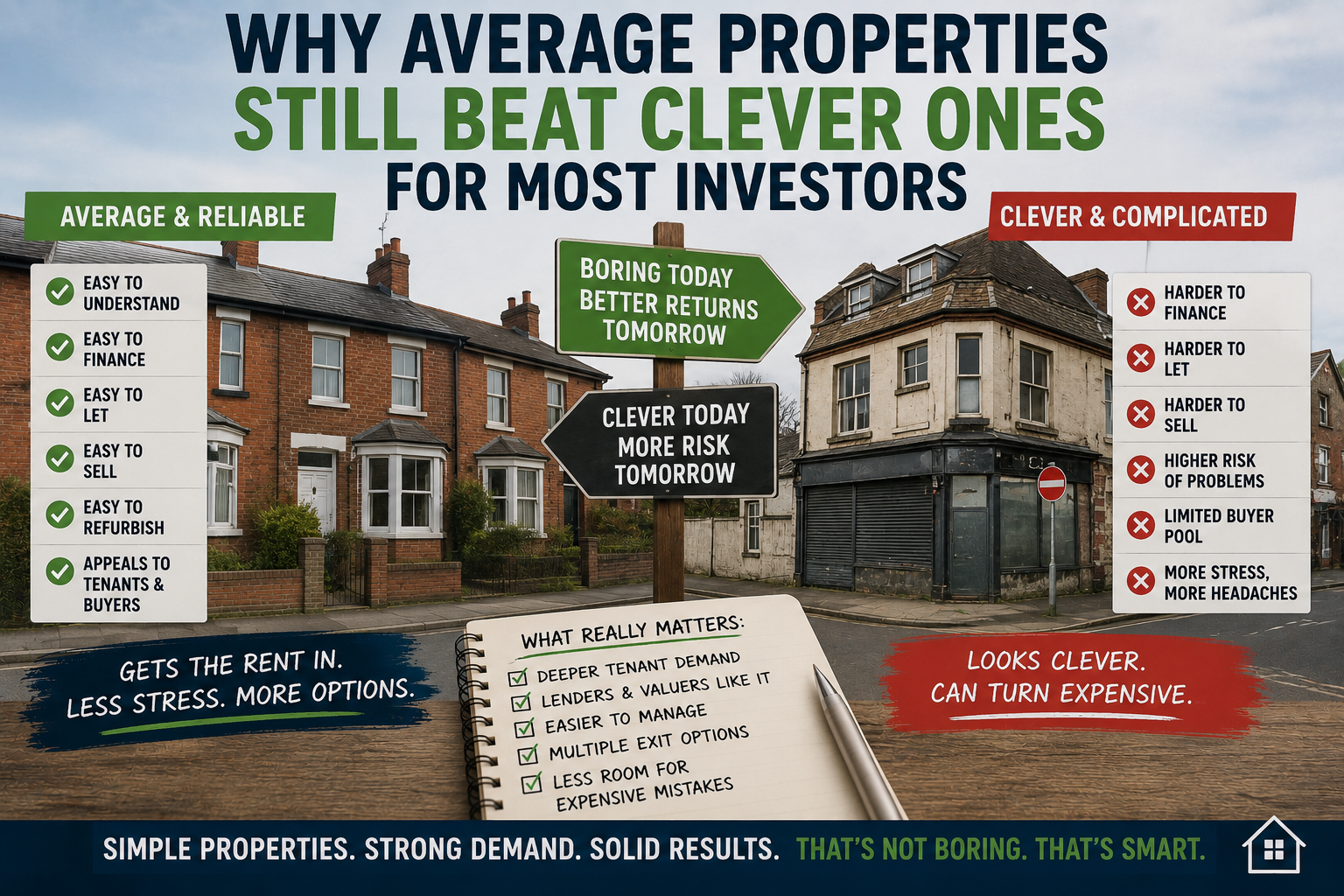
There has been talk that ‘boring’ (simple, keep to the basics) property investing will do best in 2026, so it is probably worth saying that boring properties are often best as well.
Not always, obviously.
There will always be investors who do very well out of complicated buildings, awkward titles, funny layouts, planning angles and all the rest of it. Good luck to them. Some of them know exactly what they are doing.
But for most investors, the better long-term results usually come from average properties in average areas that do average, reliable things rather well.
Which is not a slogan you are likely to see on social media.
The trouble is that “average” does not sound exciting enough. People want the deal with the hidden angle. The one that feels clever. The one that sounds impressive when explained over coffee or, worse still, in a Facebook post.
An ordinary two-bed terrace in a decent letting area does not usually get hearts racing.
But it often gets the rent in.
And that is rather the point.
Average properties tend to have a few advantages that investors consistently underestimate. They are easier to understand. Easier to value. Easier to finance. Easier to let. Easier to sell. Easier to refurbish. Easier to explain to a valuer, a lender and a future buyer.
In other words, they are easier to work with at almost every stage.
That matters more than people think.
Because property is not just about getting in cheaply. It is also about how straightforward the thing is to own, finance, improve, refinance, let and eventually sell. A property can look clever at the buying stage and turn into a nuisance at every stage afterwards.
I have seen plenty of that.
The “interesting” property often comes with some hidden sting in the tail. Maybe it is above a shop. Maybe it is non-standard construction. Maybe it is in a road where owner-occupiers will never really want to live. Maybe it is a huge flat carved awkwardly out of something that should have remained in one piece. Maybe it is technically cheap, but only because half the market cannot or will not buy it.
That is not always fatal.
But it is often expensive.
And for most investors, especially those building steadily rather than theatrically, that sort of complication is usually not where the easy money lives.
The thing about average properties is that the demand is often deeper.
Tenants understand them.
Lenders understand them.
Valuers understand them.
Future buyers understand them.
That gives you options, and options matter.
A property that is easy to let but hard to sell is not ideal. A property that is easy to buy but hard to finance is not ideal. A property that looks cheap but only appeals to a weird little corner of the market is not usually the bargain it first appears to be.
By contrast, a normal house or flat in a sensible area may not feel especially glamorous, but it often gives you more than one workable exit. You can let it. Refinance it. Sell it to another investor. Sell it to an owner-occupier. That flexibility has value, even if it does not sound very sexy.
There is also the management point.
Average properties tend to create fewer dramas.
Not no dramas, because this is property and there is always something, but fewer.
That usually means fewer nasty surprises, fewer heroic rescue missions and fewer moments where the investor suddenly discovers that what looked “slightly quirky” at purchase is actually “commercially annoying” by year two.
Again, not exciting.
But profitable.
I sometimes think investors talk themselves into complications because they want to feel they are doing something sophisticated. They do not want to believe that a perfectly ordinary property, bought at the right price and managed sensibly, can outperform something much more exotic.
But it often can.
Because simple properties leave less room for expensive misunderstandings.
That is particularly true in a market like this one, where you cannot just assume the market will forgive every weak decision. If margins are tighter and buyers more selective, then average, mortgageable, lettable, understandable property starts to look quite attractive.
Which brings us back to boring again.
Boring properties are not always the cheapest.
They are not always the most dramatic.
They are not always the ones with the most seductive before-and-after photographs.
But for most investors, they are very often the ones that make the most sense.
This is not advice, obviously. Do your own due diligence and all the rest of it.
But if I had to back one type of property for most investors in 2026, I would still back the ordinary one.
The one that works.
The one that lets.
The one that lenders like.
The one that future buyers do not have to squint at and “try to see the potential”.
Which is really just another way of saying that average often beats clever.
Especially in property.
Here’s to successful property investing.

Peter Jones
Author, property investor and ex-Chartered Surveyor
 By the way, if you’d like a deeper dive into property investing based on the real-life experience of an investor who has built a substantial multi-property portfolio, my popular e-book, The Successful Property Investor’s Strategy Workshop, explains how I built my own portfolio from scratch and the principles that can help you do the same.
For more details please click here: https://thepropertyteacher.co.uk/the-successful-property-investors-strategy-workshop