 If you are wondering what this means, HHSRS stands for the Housing Health and Safety Rating System.
I agree, it sounds boring, but please don’t click away because this is important to know.
In simple terms, it is the system councils use to assess whether a residential property contains hazards that could affect the health or safety of the people living there. It is not about whether the property looks a bit tired, or whether the kitchen is fashionable, or whether the carpets have seen better days.
It is about risk.
Could the property cause harm?
And if so, how likely is that harm, and how serious could it be?
That is the basic idea. The official guidance describes HHSRS as a risk-based tool used by local authorities to identify and protect against potential risks and hazards to health and safety from deficiencies in dwellings.
The changes I’m referring to come into force in England on 23 June 2026.
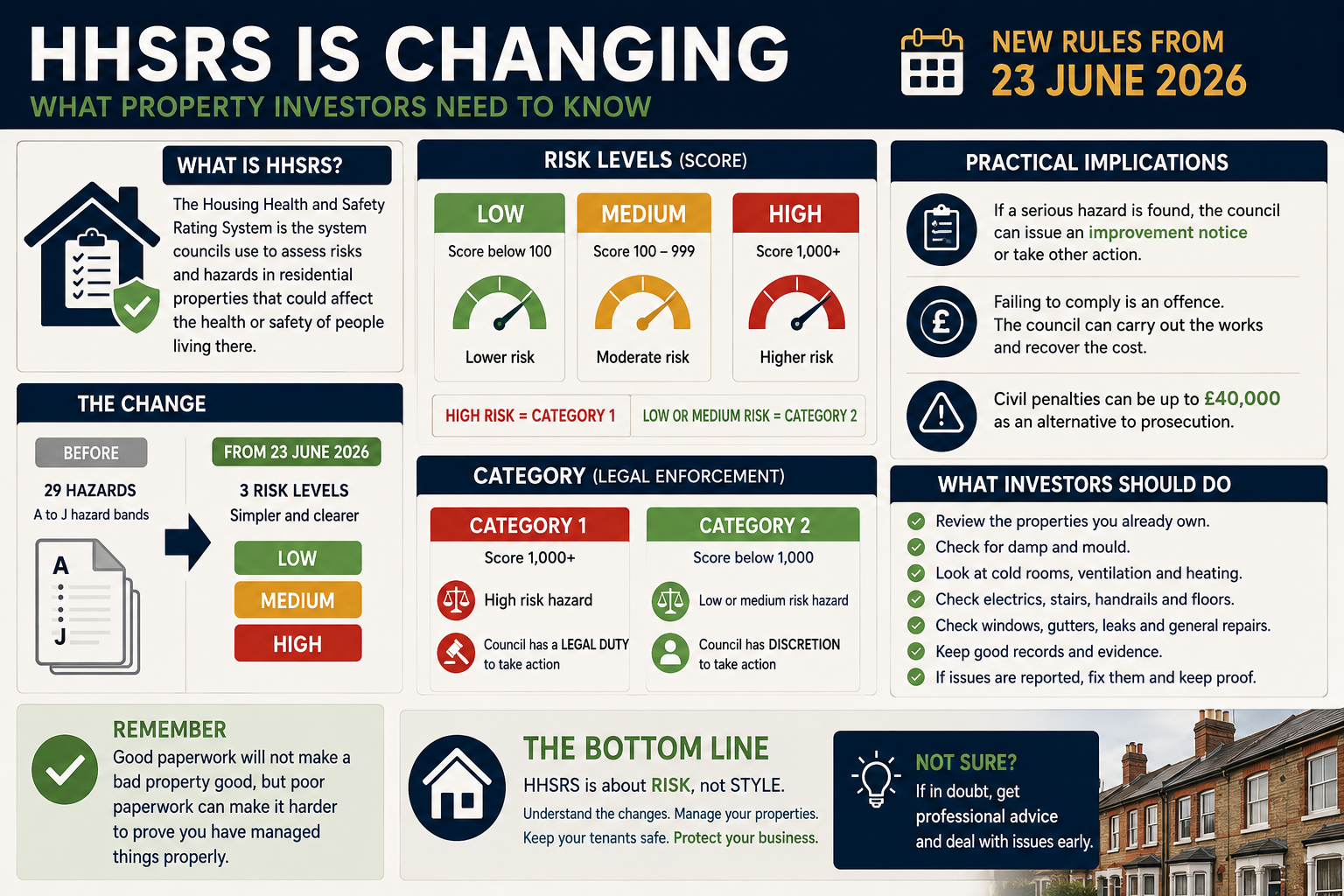
Historically, HHSRS looked at 29 hazards. These included things like damp and mould, excess cold, fire, electrical hazards, unsafe stairs, slips and trips, structural problems, hygiene issues and other risks around the home.
From June 2026, the system is being simplified. The old A to J hazard bands are being replaced with three clearer labels:
Low
Medium
High
But this is where it can get confusing.
You may also hear people talk about Category 1 and Category 2 hazards.
These are not different systems, they are part of the same system.
The Low, Medium and High labels describe the level of risk. Category 1 and Category 2 describe the legal enforcement category.
Under the updated guidance, a hazard scoring below 100 is Low, 100 to 999 is Medium, and 1,000 or more is High. A score of 1,000 or more is a Category 1 hazard. Anything below 1,000 is Category 2.
So, in plain English:
High risk = Category 1
Low or Medium risk = Category 2
The key difference is what the council can or must do.
If a council finds a Category 1 hazard, it has a legal duty to take action. If it finds a Category 2 hazard, it has discretion to take action.
For investors, especially those who already own property, this is where the practical implications start.
If a tenant complains, or the council inspects, and they find a serious hazard, this can lead to enforcement action. That might include an improvement notice requiring works to be carried out within a set timescale, or in more serious cases other action such as restrictions on use.
And this is not something to shrug off.
Failing to comply with an improvement notice without reasonable excuse is an offence. The council can also carry out the required works and recover the cost, and civil penalties can now be up to £40,000 as an alternative to prosecution.
So this is not just paperwork, this can become expensive.
For existing investors, I think the sensible response is to review what you already own.
Not panic, just review.
Hopefully there’s nothing to see, and regular inspections will confirm that.
But, in any case, have regular inspections and check for damp and mould.
Look at cold rooms.
Check ventilation.
Check the heating.
Check the electrics.
Check the stairs and handrails, and check for loose carpets, uneven floors, broken paths, unsafe windows, leaks, defective gutters and general repair issues.
And keep records, including inspection notes, photos, invoices, certificates, and emails.
If something has been reported and sorted, keep the evidence that it was sorted.
Hopefully, if you have managing agents, they will do this, but make sure they are.
If you don’t have managing agents, you will have to do this yourself, or at least arrange for it to be done properly.
Just remember that good paperwork will not make a bad property good, but poor paperwork can make it harder to prove you have managed things properly.
Here’s to successful property investing.

Peter Jones
Author, property investor and ex-Chartered Surveyor
 PS. By the way, if you’d like a deeper dive into property investing based on the real-life experience of an investor who has built a substantial multi-property portfolio, my popular e-book, The Successful Property Investor’s Strategy Workshop, explains how I built my own portfolio from scratch and the principles that can help you do the same.
For more details please click here: https://thepropertyteacher.co.uk/the-successful-property-investors-strategy-workshop