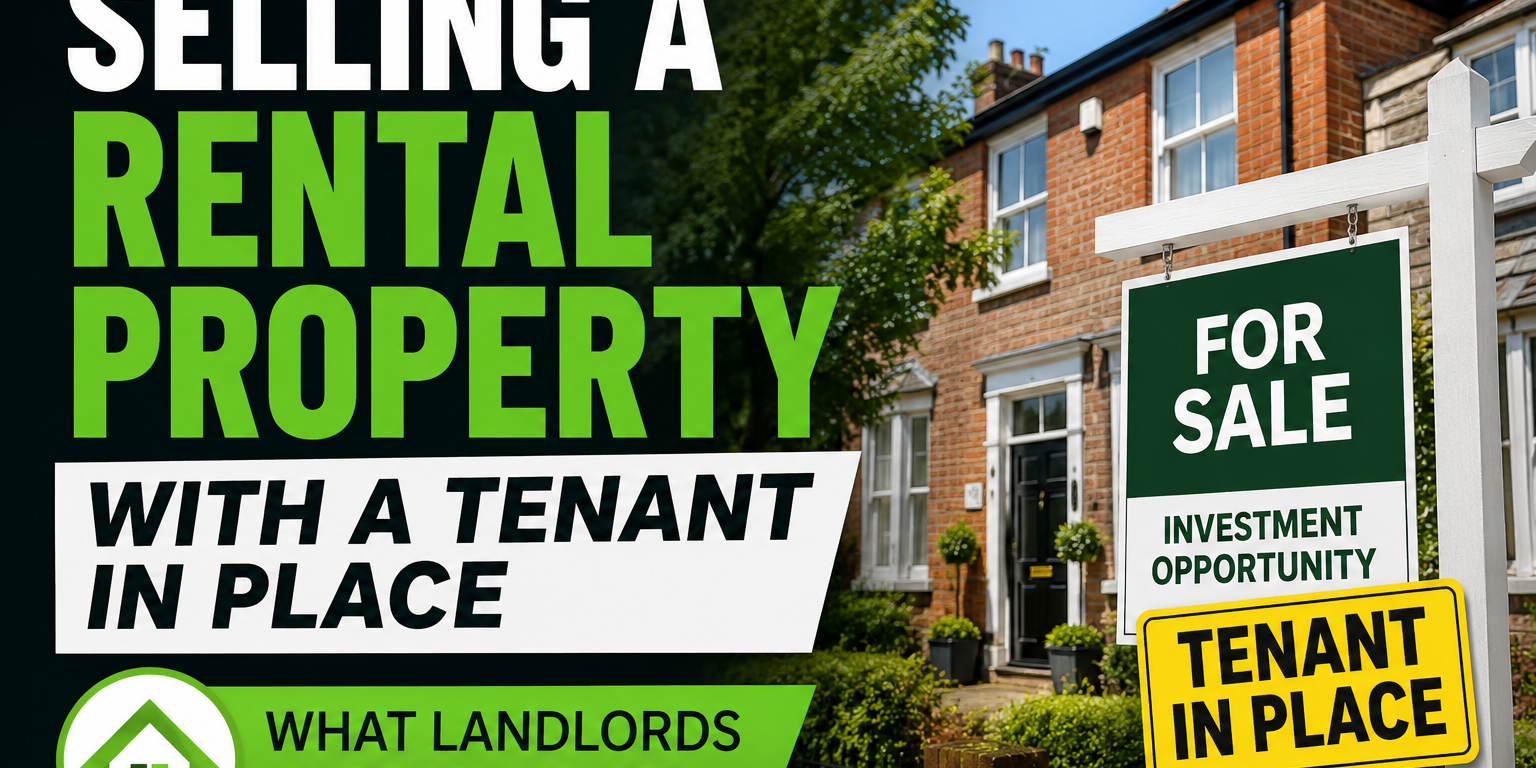
Recently, a past mentee approached me to ask specifically whether, with the Renters’ Rights Act in place, it is still possible to sell a tenanted property.
I think this is a question many of us might be asking, so I’m going to share the gist of what I told him.
As ever, this isn’t legal or financial advice. It’s just how I understand the position, and what I’d be thinking about if I were in the same situation. If you are thinking of selling, especially if there is a tenant in place, please speak to your solicitor, your agent, and anyone else suitably qualified before making decisions.
Can You Still Sell With A Tenant In Place?
My understanding is yes, you can still sell a rental property with a tenant in place.
The buyer simply takes over as the new investor and becomes the tenant’s new landlord. The tenancy continues, but the landlord changes.
The important distinction is between selling with a tenant in place and selling with vacant possession.
If you sell with the tenant in place, you are normally selling to another investor. That can be relatively straightforward if the buyer likes the tenant, likes the rent, and likes the numbers.
But it may reduce your buyer pool.
Most owner-occupiers do not want to buy a property with a tenant still living in it. They want to move in. So if your best buyer is likely to be a first-time buyer, downsizer, or owner-occupier, you may need vacant possession.
That is where the Renters’ Rights Act becomes more relevant.
Selling With Vacant Possession
Once Section 21 goes, investors will no longer be able to assume they can simply serve a no-fault notice and get the property back on the old timetable.
If you want vacant possession because you intend to sell, the relevant route is likely to be the possession ground for sale, commonly referred to as Ground 1A.
But that does not mean you can remove the tenant overnight.
My understanding is that four months’ notice is required before applying to court for possession, and Ground 1A cannot be used within the first 12 months of the tenancy.
So if you are planning to sell with vacant possession, time matters.
You may also need evidence that you genuinely intend to sell. That could include estate agent instructions, solicitor involvement, marketing plans, or other documentation. This is one of those areas where guessing is not a great strategy. Speak to a solicitor before doing anything, because a defective notice or muddled process could waste months.
Selling With The Tenant In Place
The alternative is to sell as a tenanted investment.
This can work well if the property is in an investor-friendly area and the rent supports the value.
In some cases, selling with the tenant in place may be better for everyone. The tenant stays where they are. The buyer receives rent from day one. You avoid a vacant period. And you may avoid the uncertainty and delay of trying to get possession first.
But the numbers need to be right.
An investor will normally look at the rent, yield, condition, financeability, compliance documents, EPC position, lease details if it is a flat, service charges, ground rent, arrears history, and the quality of the tenancy.
They are buying an income-producing asset, not just bricks and mortar.
So make it easy for them.
Have the tenancy agreement ready. Have the deposit paperwork. Have gas safety certificates, electrical certificates, EPC, licence details if relevant, rent statements, inspection records, and any correspondence about rent increases or repairs.
A serious buyer will ask for these things anyway. If you can provide them quickly, you look organised and credible.
Who Might Buy It?
There are several possible routes.
The obvious one is to speak to your managing agent. They may already have clients looking to buy more rental properties. Local agents may also know investors who are active in that area.
You could also speak to auction houses. Some investors still like auctions because they can see the opportunity quickly and move fast. Traditional auction can work for the right property, although you need to understand the fees, reserve price, legal pack requirements, and likely buyer profile.
There is also the Modern Method of Auction. Personally, I would be cautious and make sure I understood the fee structure before committing.
Often the buyer pays a reservation fee, and a sensible buyer may simply deduct that fee from what they would otherwise have paid for your property. So it may not always be the most financially efficient way to sell, even if it appears to offer speed and certainty.
There are also specialist companies and platforms that deal with tenanted properties. For example, the NRLA contacted members about Landlord Property Exchange, which they describe as specialising in selling rented property. I have not used them, and this is not a referral or recommendation, but it may be worth investigating if you are thinking of selling.
There are also firms such as LandlordBuyer, Good Move, We Buy Any Home, National Property Buyers, and others who say they buy, or help sell, rented property.
Again, I have not used these firms. I do not know how they operate, what prices they achieve, what fees they charge, or whether they would be right for any particular property.
If you Google around, you will find many more property firms, estate agents, investors and deal sourcers who may be able to help.
But treat this seriously.
Check who you are dealing with. Ask how they make their money. Ask whether they are buying directly or introducing you to someone else. Ask what fees apply. Ask whether you are tied in. Ask what happens if the buyer pulls out.
Do your due diligence properly.
What Should You Do First?
Before choosing a route, I would start with three questions.
What is the property worth vacant?
What is it worth tenanted?
And how long would it realistically take, and cost, to get vacant possession?
That gives you a proper comparison.
If selling vacant might get you a higher price, but it takes six months, creates legal costs, loses rent, and adds uncertainty, it may not be the better route.
On the other hand, if the property is much more attractive to owner-occupiers than investors, vacant possession may produce a stronger result.
It depends on the property, the tenant, the rent, the area, and your own priorities.
The Renters’ Rights Act does not mean investors cannot sell.
But it does mean the process needs more thought, more planning, and fewer assumptions.
So if you are thinking of selling, start early, get your paperwork in order, understand your buyer pool, and choose the route that fits the property rather than the one that sounds easiest.
Here’s to successful property investing.

Peter Jones
Author, property investor and ex-Chartered Surveyor
 PS. By the way, if you’d like a deeper dive into property investing based on the real-life experience of an investor who has built a substantial multi-property portfolio, my popular e-book, The Successful Property Investor’s Strategy Workshop, explains how I built my own portfolio from scratch and the principles that can help you do the same.
For more details please click here: https://thepropertyteacher.co.uk/the-successful-property-investors-strategy-workshop