For a long time, some investors didn’t worry too much about monthly cashflow.
That wasn’t always reckless. In a rising market, a property that only just covered its costs could still (just about) make sense if it was also increasing in value. The rent paid the bills, more or less, and the profit was being made through growth in the value of the asset.
For some ‘robust’ investors, that worked.
But it’s a much harder argument to make now.
Higher mortgage rates have changed the calculation. A property that looked acceptable at 2% or 3% will look very different at 6%, or even 5%. Rents have increased in many areas, but so have repairs, insurance, licensing, compliance costs, service charges, letting fees and tax.
So cashflow is not something to think about after the purchase. It has to be tested before we buy.
Capital Growth Is Not A Plan On Its Own
Capital growth is still important.
Most investors would rather own a property that increases in value over time than one that doesn’t. But capital growth is uncertain. It can come quickly, slowly, or not at all for longer than we would like.
It depends on the market, the area, the economy, interest rates, buyer demand and a long list of other things we don’t control.
Cashflow is more immediate.
Either the rent covers the costs and leaves something over, or it doesn’t. There can be assumptions in the numbers, obviously, and we can still get them wrong. But at least we can test them.
We can look at the rent.
We can estimate the mortgage.
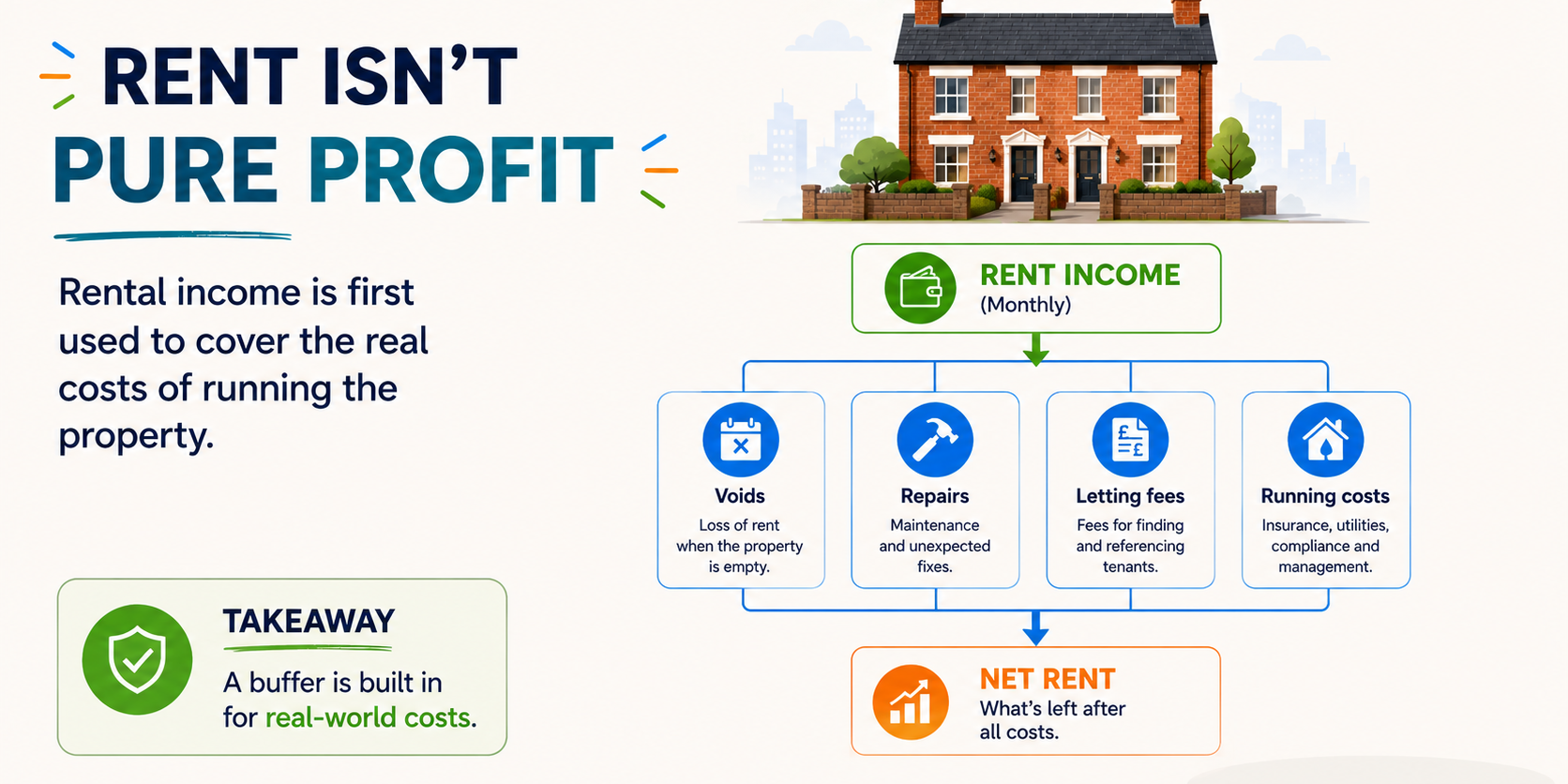
We can allow for management, maintenance, voids, insurance, compliance, accountancy, licensing, service charges if relevant, and anything else likely to turn up as a cost.
Then we can ask a simple question.
Is this property likely to make a monthly surplus?
If the answer is no, we need a very good reason for buying it.
The Problem With Thin Margins
A property that only just works on paper may not work in real life.
Tenants leave. Boilers break. Roofs leak. Letting agents charge fees. Councils introduce licensing schemes. Interest rates change. Refurbs cost more than expected. Rents don’t always rise exactly when we want them to.
None of this means we shouldn’t buy property. It means we should build in some safeguards.
A property that produces a decent monthly surplus gives us options. It can absorb a repair bill. It can cope with a void. It can sit in the portfolio without constantly needing to be subsidised from our other income.
A property that is already tight from day one can become uncomfortable very quickly.
And once a property is uncomfortable, decision-making can become worse. We may delay repairs, resent the tenant, avoid spending money we should spend, or rush to sell at the wrong time.
That is not a good investment position to be in.
Cheap Doesn’t Always Mean Profitable
This is especially relevant with cheaper properties.
I like cheap and cheerful property. There can be good opportunities below £100k, particularly where rents are strong in relation to purchase price.
But a high yield on paper doesn’t always become profit in the bank.
A cheap property in the wrong street, with weak tenant demand, poor condition, high turnover, awkward neighbours, or constant maintenance can soon become less attractive.
So yes, yield is important. But it needs to be real yield, not fantasy yield.
That means realistic rent, realistic costs, realistic management, and realistic expectations of the type of property and area.
What Should Investors Do?
Start with the rent, but don’t stop there.
Work backwards from the likely income and deduct the likely costs. Be slightly pessimistic. Not ridiculously pessimistic, otherwise none of us would ever buy anything. But don’t use best-case figures and pretend they are normal.
Ask what happens if the interest rate is higher when the mortgage deal ends.
Ask what happens if the property is empty for a month.
Ask what happens if you need to spend £2,000 on repairs in the first year.
Ask what happens if rents don’t rise as quickly as expected.
If the deal still works after those questions, it may be worth a closer look.
If it only works when everything goes perfectly, it probably doesn’t work.
The Bigger Point
Cashflow is not the only reason to buy property.
Sometimes we buy for future value. Sometimes we buy because we can add value through refurbishment. Sometimes we buy because the area has strong long-term prospects. Sometimes we buy because the property fits a bigger strategy.
But in the current market, monthly profit deserves more attention than it had when money was cheap and values were rising more easily.
This isn’t advice, obviously. Everyone’s circumstances are different, and it’s worth speaking to a good broker and accountant before making decisions.
But for most investors, the basic principle is simple.
A property should earn its place in the portfolio.
And at the moment, cashflow is a very good place to start.
Here’s to successful property investing.

Peter Jones
Author, property investor and ex-Chartered Surveyor
 PS. By the way, if you’d like a deeper dive into property investing based on the real-life experience of an investor who has built a substantial multi-property portfolio, my popular e-book, The Successful Property Investor’s Strategy Workshop, explains how I built my own portfolio from scratch and the principles that can help you do the same.
For more details please click here: https://thepropertyteacher.co.uk/the-successful-property-investors-strategy-workshop