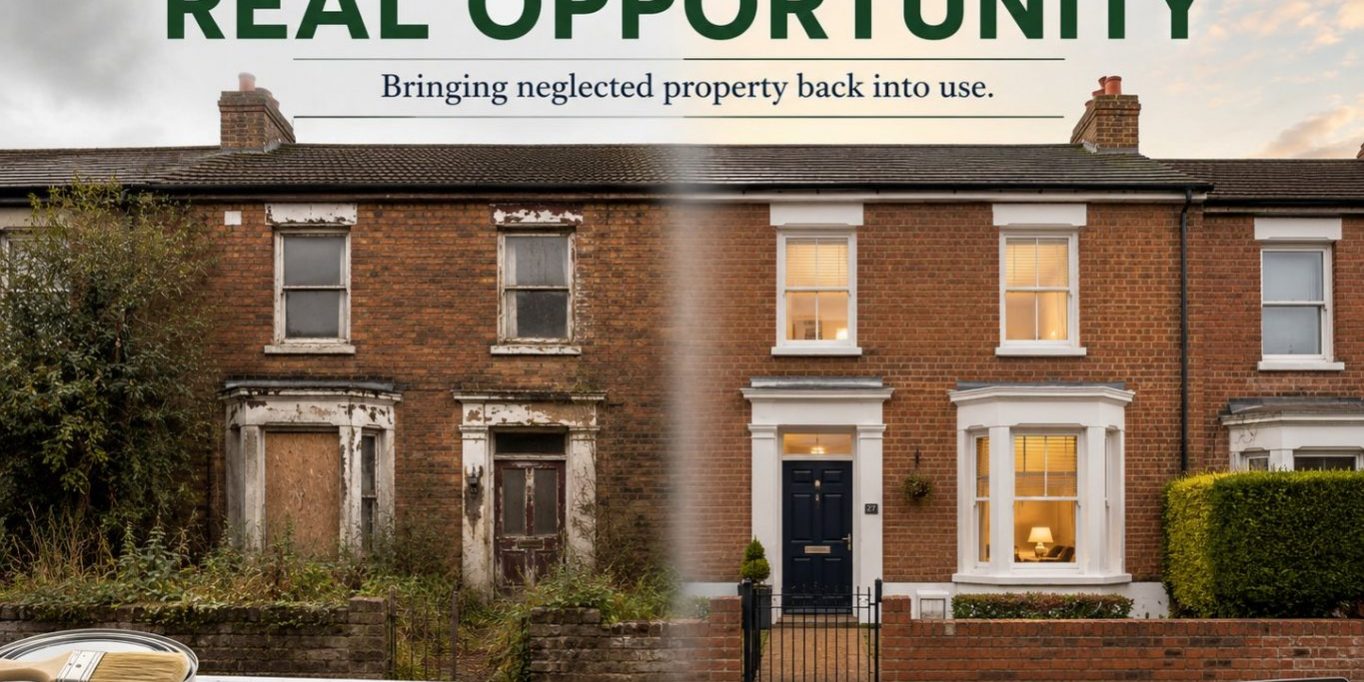
There are a lot of empty homes in England.
According to the latest council taxbase figures, there were around 542,000 dwellings recorded as empty for council tax purposes in October 2025, excluding exempt properties. The Empty Homes Network says that, once second homes and unoccupied exemptions are included, the total number of homes not in permanent use is now just over one million.
That is a lot of unused housing.
Of course, not every one of those homes will be suitable, available, or sensible for investors to buy.
And yet, when investors buy tired, neglected or empty properties and bring them back into use, they are still often treated as if they have done something wrong.
This has always struck me as odd. Not surprising, perhaps, but odd.
Because in many cases, the so-called “ordinary buyer” was never going to buy that property anyway.
They either couldn’t get a mortgage on it, couldn’t afford the works, didn’t want the risk, didn’t have the time, didn’t have the trades, or understandably didn’t want to spend six months dealing with damp, rewiring, rotten windows, old kitchens, leaking roofs and the thousand other things that come with an unloved property.
And fair enough, most people want a home they can move into.
They don’t want a project that eats their weekends, empties their savings and introduces them to the emotional world of builder availability.
So, when an investor buys that sort of property, spends the money, takes the risk, manages the refurb and brings it back into use, that should be recognised as a useful thing.
But often it isn’t. Why?
Because the investor might make a profit.
And that seems to be the part many people struggle with.
There is an assumption in some quarters that profit is somehow suspicious. If an investor buys an empty property, improves it and makes money, the story quickly becomes that they have taken a home away from someone else.
But what if no one else was going to do it? What if the property was sitting empty precisely because it needed more money, effort, knowledge and risk than most buyers could sensibly take on?
Isn’t the investor’s profit the reward for solving that problem?
I’m not saying every investor is a saint. We all know that isn’t true.
And I’m not saying every deal is some noble social mission. It isn’t.
But the idea that profit automatically makes the activity bad is just lazy thinking, in my opinion.
If a builder is paid to do the work, we don’t usually object to the builder making a profit.
If a surveyor inspects the property, we don’t expect them to do it for free.
If a solicitor, broker, lender, letting agent, surveyor or building control officer all take their fees along the way, that is apparently just how the system works.
But if the investor takes the biggest risk, puts the capital in, carries the cost, and hopefully makes a profit at the end, suddenly we are meant to feel faintly embarrassed about it.
I don’t think we should.
Profit is not the problem. The problem is poor quality housing, badly managed property, and homes sitting empty when they could be used.
A good investor can help solve that.
Not every empty home will work as an investment. Some are empty for good reasons. Some are in the wrong place. Some have legal problems, ownership issues, structural problems or costs that simply do not stack up.
But some will make sense.
And for investors who can see past the mess, understand the numbers, organise the works and provide decent housing afterwards, there may still be opportunity.
That is one of the reasons I still like property renovation.
You can take something tired, neglected and underused, and turn it back into a home.
You can create value rather than just hope the market gives it to you.
And yes, hopefully you can make a profit.
There is nothing wrong with that.
Here’s to successful property investing.

Peter Jones
Author, property investor and ex-Chartered Surveyor
 PS. By the way, if you’d like a deeper dive into property investing based on the real-life experience of an investor who has built a substantial multi-property portfolio, my popular e-book, The Successful Property Investor’s Strategy Workshop, explains how I built my own portfolio from scratch and the principles that can help you do the same.
For more details please click here: https://thepropertyteacher.co.uk/the-successful-property-investors-strategy-workshop