I met someone recently who had bought a few properties several years ago and was still waiting for them to produce enough income to replace his salary.
The real issue was not that he had bought property.
The issue was that he had let them sit there for several years, hoping something would change when, in reality, it was highly likely nothing would change for the better.
His situation had changed. The market had changed. Finance had changed. Legislation had changed. The world around him had changed.
But his approach hadn’t. He was still doing property the same way as he had years ago when he bought his first property.
That, I suspect, is where many investors are now. They bought in one world and are now operating in another.
Cash Flow Or Equity?
The first uncomfortable question is whether the properties were ever really suited to the outcome he wanted.
If an investor wants monthly income, yield is important.
That is why I have generally favoured cheap and cheerful properties, often up north, because cheaper properties tend to produce higher gross yields and, consequently, better cash flow, relatively speaking.
Higher-value properties in lower-yielding areas may give you equity growth over time. But equity does not grow consistently, and is unpredictable. There are also times when property values, and therefore equity, can fall.
Trying to get strong capital growth and strong monthly cash flow from expensive, heavily mortgaged single lets is asking a lot. It can happen, but I wouldn’t build a plan around it.
Fix The Basics First
And so, as I talked to him, I suggested that before he did anything clever, he should check the boring stuff.
The way I saw it was that, if he was to rescue his dreams, he needed to work through a series of decisions rather than try one big fix. Although, as you’ll see, the ultimate solution could end up being one big fix.
My first suggestion was to look at the basics.
Was he on top of, and in control of, his costs? Were there costs he could trim without hurting his portfolio?
Was he getting the best rent?
I know it’s all too easy not to keep rents at market level, if only because you lose track and lag behind. Even more so when you have a great tenant and don’t want to push the rent too hard, because you want to keep them, and keep them happy.
Before you know it, they are on a very low rent, and you realise you didn’t do them any favours when catching up with true market rent causes them hardship.
He also needed to look at true net cash flow.
By that I don’t mean rent minus mortgage payment. That is only part of the picture. True net cash flow means allowing for management fees, insurance, repairs, maintenance, compliance costs, voids, service charges where relevant, tax, and the general wear and tear that comes with owning property.
If those costs aren’t being properly tracked, it’s very easy to think a property is performing better than it really is.
Are your managing agents doing everything the right way and containing costs on your behalf? Does the management of the portfolio need changing or tweaking to keep costs and rents at the right balance?
These aren’t glamorous questions, but they are important.
Review The Finance
Then I suggested he looked at his finance.
Was he paying unnecessarily high variable rates? Could he cut his mortgage payments by refinancing some or all of the properties? Either with his current lender or, more likely, with a different lender?
Would it make sense to put some or all of them on fixed terms?
Was he too over-leveraged? Would it make sense to start paying some or all of the mortgages down to bring a better balance of leverage and, with it, a better finance cost to rent ratio?
That may be more of a long-term fix, I accept, but it is still part of the discussion.
Of course, I’m not a financial advisor and none of this is financial advice, and so a portfolio review like this should always be done with a professional mortgage broker or a qualified financial advisor.
Then Decide Whether To Rebalance
If the basics and the finance still don’t get you where you want to be, the next question is whether the portfolio itself needs restructuring.
Would he sell some properties if they are tying up capital but producing very little income?
One benefit of selling weaker performers is that the equity released could be used to reduce debt.
Or he could redeploy any capital released into higher-yielding areas where he could potentially receive better cash flow, relatively speaking.
What if that meant selling all of his properties and starting over in a new area where his plan worked?
That is a big decision, but surely a better decision than just hoping that one day things will change?
The Really Hard Medicine
And finally, would he, should he, consider adopting a different property strategy?
Was he pursuing the right property strategy anyway? Was it the right strategy for the area he had bought in? Was it the right strategy for the stage of the property cycle we are in now, which is something many of us don’t often consider?
Then comes the really hard question.
Combining the last two points, would he be better served in achieving his goals by selling up, changing area and starting afresh somewhere new with a completely different strategy?
I understand this would be a big, hard decision to make but, again, we really only have one stab at this. So if it isn’t working now, then why not at least consider it, assuming you really have tried everything else to make it work?
This is the point.
A portfolio that isn’t performing is not automatically a failed portfolio.
But it does need reviewing.
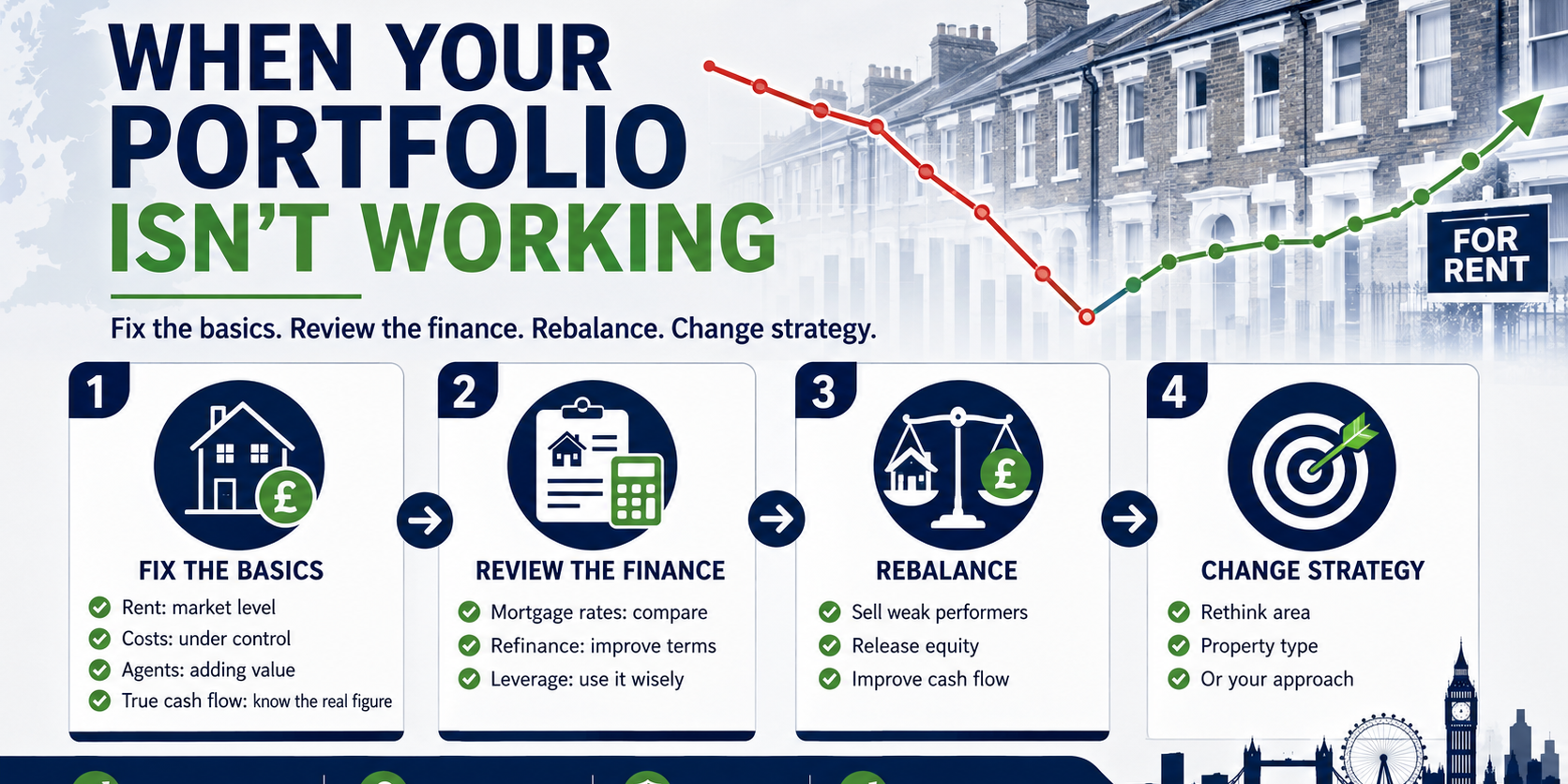
The sequence is simple enough: fix the basics, review the finance, then decide whether to rebalance or change strategy.
Don’t just let it sit there hoping something will change.
Hope is admirable, but avoidance just leads to trouble.
Here’s to successful property investing.

Peter Jones
Author, property investor and ex-Chartered Surveyor
 PS. By the way, if you’d like a deeper dive into property investing based on the real-life experience of an investor who has built a substantial multi-property portfolio, my popular e-book, The Successful Property Investor’s Strategy Workshop, explains how I built my own portfolio from scratch and the principles that can help you do the same.
For more details please click here: https://thepropertyteacher.co.uk/the-successful-property-investors-strategy-workshop