It’s a funny thing — ask most property investors why they got into it, and you’ll hear some version of “freedom”, “flexibility”, or “to retire early”.
Freedom was my big motivator.
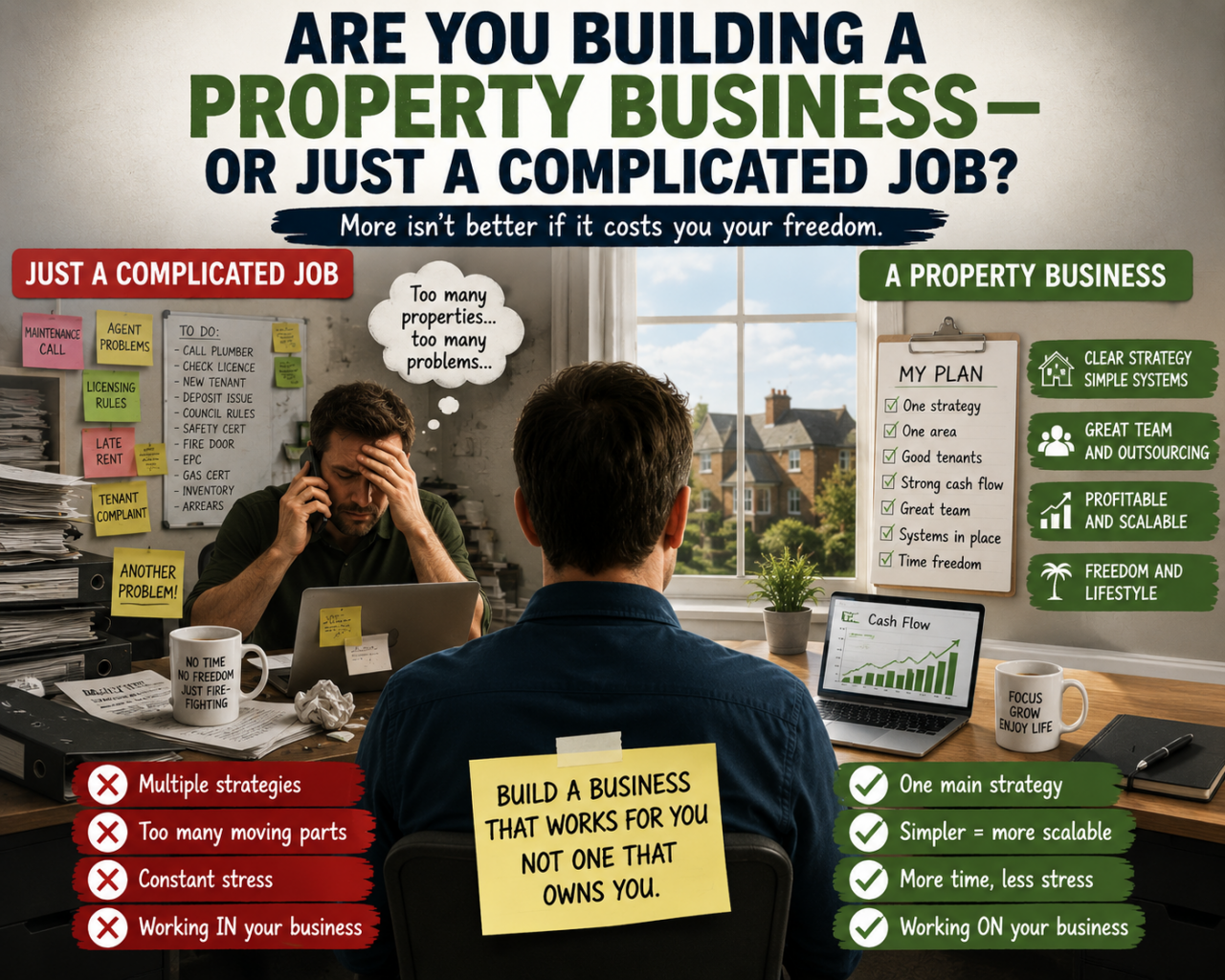
But give them a few years and they’re flat out, juggling maintenance calls, managing five different letting agents, and trying to keep up with licensing rules in three local councils.
If not those specific tasks, there will be something to keep them occupied and busy whilst they earn their “passive income”.
Somewhere along the line, the dream morphed into something else.
Obviously, I get it. I’ve been there myself — adding properties, deals, strategies — thinking that more equals better.
In fact, one of my guiding principles in life is, “More is better than less”, but in my heart of hearts I know that isn’t always the case. Unlike Gordon Gekko, I will not say, “Greed is good”.
But this was how it was until I realised I wasn’t building freedom. I was just building a bigger, messier, more time-consuming version of the job I thought I’d left behind.
OK, there’s a bit of artistic licence in that. It wasn’t by any means identical in terms of processes, but it was worryingly similar in terms of time, effort and stress.
More Isn’t Always More
There’s a kind of pressure in the investor world.
If you’re not growing, you’re dying. If you aren’t moving forward, you’re moving backwards. If you’re not expanding, you’re stagnating. If you’re not hitting “X” number of properties by “Y” date, you’re falling behind.
But here’s a question no one asks: what kind of portfolio do you actually want? And why?
Is it:
- A small number of high-quality, low-hassle properties that give you consistent but small cash flow?
- A bigger portfolio of high-yielding single lets that needs a managing agent, systems, and processes?
- Or a Frankenstein’s monster of single lets, HMOs, serviced accommodation and lease options, scattered across the UK?
Because what you create, and how you set it up, will affect your peace of mind.
Why This Matters Today
Right now, with interest rates where they are and the cost of everything creeping up, it’s never been more important to know what you’re building.
It’s easy to get sucked into a new strategy — “I’ll try a BRR”, “maybe SA will work here”, “someone on TikTok just bought 12 HMOs in 12 months, I should probably…”
But chasing multiple strategies with multiple moving parts? That’s not investing. That’s admin.
And unless you’re really into spreadsheets and midnight calls from Airbnb guests, it’s not going to give you the life you hoped property would.
The Single Strategy Advantage
Over the years, I’ve realised boring is good in property.
Some of the most successful investors I know are boring. One area, one strategy, repeat until wealthy.
Nothing fancy. They’re not chasing trends. They’re not signing up to masterminds to learn yet another new strategy every six months.
They just know what works for them — and they stick to it.
It’s the property version of staying focused.
I’m not saying don’t grow.
But I am saying don’t grow without clarity.
Know what you want your life to look like, and then build a portfolio that matches that — not one that impresses people on Facebook.
The problem is, some, probably many, property investors start by jumping in before they work out where they actually want to go, and by the time they realise it isn’t exactly what they want, it’s hard to change course and tweak things back on track.
And, by the way, I’m not saying don’t keep learning either.
Just don’t let your new learnings be the excuse to keep chopping and changing what you do until after you have something that works up and running.
A Bit of Honesty
At one point, I had properties all over the place.
Some bought off-plan — well, one, and to be fair the test of time showed it was actually a good investment. Some HMOs in a northern town — definitely not a good idea. Some single lets in areas I didn’t know that well and ended up selling on again.
And the ultimate nightmare: off-plan overseas apartments that were never built and which ate up a massive deposit when the developer went bust.
The trouble was, I was getting emotional and buying the dream, meaning I’d say yes to a deal because it looked good, and not because it fitted any sort of plan.
It made me feel like I was progressing.
But I wasn’t.
I was just making my life harder.
And in ways I was even going backwards.
Eventually, I had to strip it back — sell off the ones that were more trouble than they were worth, focus on what actually delivered value, and make the whole thing simpler.
And definitely drop the idea that buying overseas was a fun thing to do.
And do you know what?
The income didn’t drop that much. In fact, when things stabilised, I had more cash left at the end of each month.
But the stress definitely did.
So What’s the Takeaway?
- More deals usually means more work, unless you’ve got systems in place to help share the load. And even then, they need managing, and you may well need to outsource to a professional property manager.
- Clarity beats complexity. Know what lifestyle you want, then build your business or portfolio to create that.
- Stick to one main strategy unless you’ve got a team, and the brain space, to manage the chaos and make it profitable.
- Sometimes, selling is smart. Let go of the properties that are dragging you down. There’s no prize for being stubborn.
Property can absolutely give you the life you want — but only if you’re honest about what that life is, and you don’t sabotage it by trying to build something bigger than it needs to be.
So maybe it’s time to stop asking, “How many have I got?” and start asking, “Is what I’ve built actually working for me?”
Because if the answer is no, adding the next deal probably won’t fix it.
Here’s to successful property investing.

Peter
Author, property investor and ex-Chartered Surveyor
 PS. By the way, if you’d like a deeper dive into property investing based on the real-life experience of an investor who has built a substantial multi-property portfolio, my popular e-book, The Successful Property Investor’s Strategy Workshop, explains how I built my own portfolio from scratch and the principles that can help you do the same.
For more details please click here: https://thepropertyteacher.co.uk/the-successful-property-investors-strategy-workshop