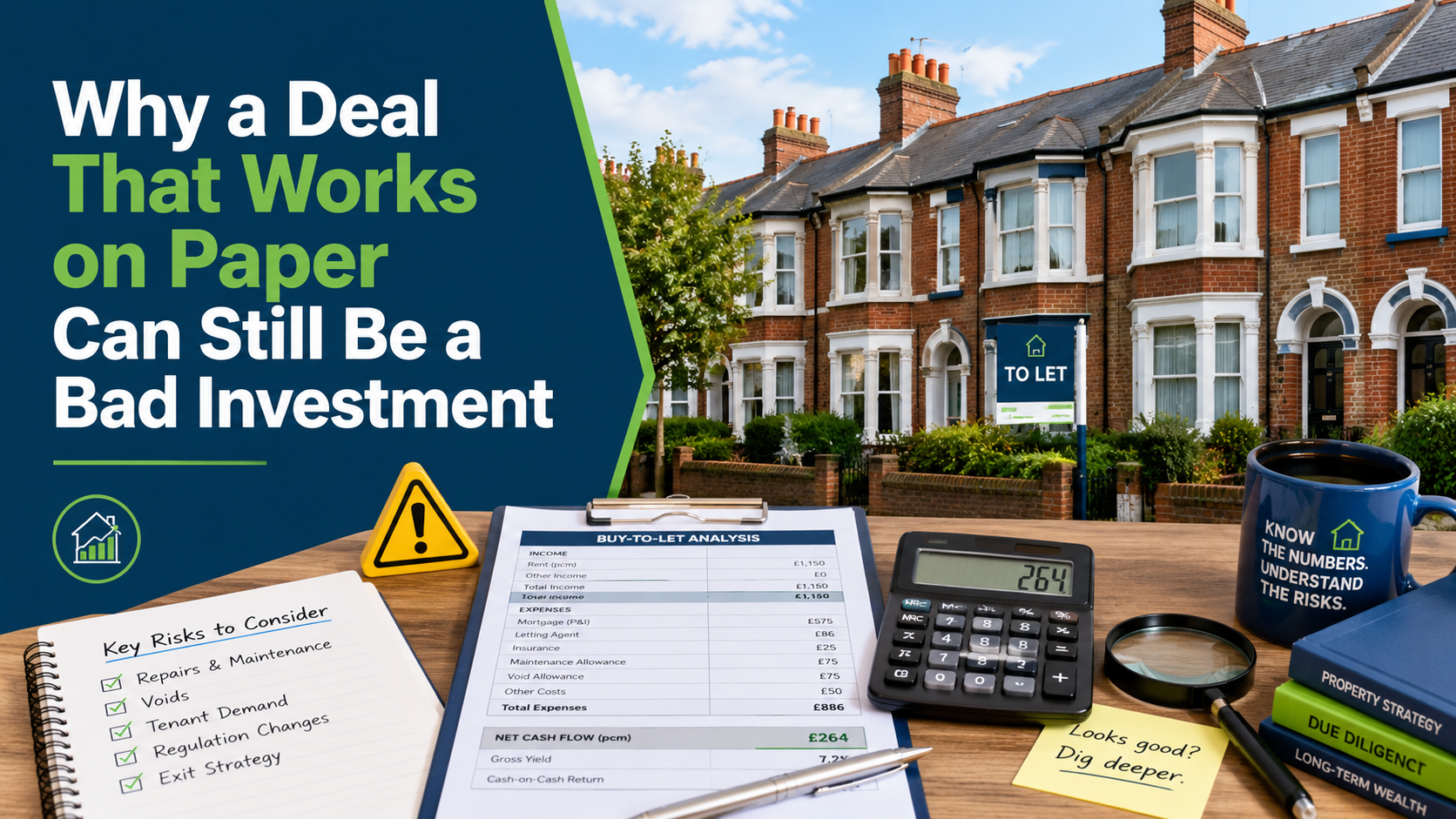
One of the easiest ways to fool yourself in property is to make a deal work on a spreadsheet and then assume that means it works in real life.
Sadly, property is not that simple.
I’ve seen plenty of deals over the years where the numbers looked perfectly respectable at first glance. Decent yield. Rent covers the mortgage. A bit left over each month. Nothing obviously wrong. And yet, when you look more closely, the property is actually a liability.
Not because the maths is wrong, exactly.
But because the maths is incomplete.
And that, I think, is one of the biggest traps investors fall into, especially when they are still fairly new and slightly over-excited by the fact they’ve found something that appears to “stack up”.
The gross yield trap
The first problem is that too many people stop at the gross yield.
They see a cheap and cheerful terrace at, say, £85,000, renting at £750 a month, and think, “That’ll do nicely.” On paper, the gross yield looks attractive. Certainly more attractive than a flat in the South costing three times as much but only bringing in twice the rent.
But gross yield is only the start.
It tells you something, but not enough to base investing decisions on.
It does not tell you how often the boiler will break, whether the roof is getting near the end of its useful life, how management-heavy the property will be, whether the tenant demand is stable, whether the area is improving or declining, or how much of your life you are going to spend dealing with things you never even thought to ask about before you bought it.
And, of course, it does not tell you what happens when the property is empty.
A property with a strong gross yield can still be a poor investment if it is unreliable, fragile, or constantly needs money thrown at it.
Cash flow is not the same as safety
This is the next thing people miss.
A deal can show positive monthly cash flow and still not be especially safe.
If you’ve only got £100 or £150 a month left after mortgage and normal costs, that may technically be positive. And yes, you may not lose money this month. But that does not mean the property is robust.
Because one void, one unexpected repair, or one missed rental payment and suddenly your “positive cash flow” starts looking very thin indeed.
This is why I think investors need to stop asking only, “Does it cash flow?”
The better question is, “How much bad luck can this property absorb before it becomes a nuisance?”
That is a much more useful question.
Because bad luck, in property, is not really bad luck at all. It is just part of the business.
In fact, I think I’d rather call it unforeseen circumstances.
Something always goes wrong eventually.
The key thing is making sure that when it does, the property does not create a problem you cannot comfortably absorb.
The property has to suit the area
Another thing people do is buy based on a formula rather than a market.
They decide they want a two-bed terrace, or a flat, or a little HMO, and then they go out looking for that type of property almost regardless of where they are buying.
To me, that seems like doing things backwards.
The first question should be: what works well here?
Not in theory. Not on YouTube. Not in some other town fifty miles away. Here.
In one area, a basic two-bed terrace might let all day long and attract decent long-term tenants. In another, the same house might be the sort of property that gets churn, arrears and wear and tear at a level that makes positive cash flow a lottery.
Likewise with flats. Some are brilliant. Some are money pits, depending on the service charge, the lease and the block itself.
It depends on the local market, the local tenant base, the supply, the demand, the management issues, the lease, the service charge, the building, and whether there is some nasty surprise lurking in the small print.
So a deal is not good just because it meets a rough formula.
It has to suit the area, the tenant market, and your own tolerance for risk.
Your exit matters more than people think
The other thing I’d be looking at is this: if I had to sell this in five years, who exactly am I selling it to?
That matters.
A lot.
Because if the only person likely to buy it is another investor, then the numbers need to look good enough for an investor. If it will appeal to an owner-occupier as well, that gives you more flexibility. More flexibility usually means more safety.
And that is before we even get on to lending.
Will lenders like it? Is it mortgageable in a straightforward way? Or is it one of those properties that always seems to come with a story?
Stories are fine in newsletters. They are less useful in mortgage applications.
So what am I really saying here?
I’m saying a deal is not “good” just because the spreadsheet says yes.
The spreadsheet matters, obviously. You’d be mad not to run the numbers properly.
But the numbers are only one part of it.
You also need to understand the property, the area, the likely tenant, the likely costs, the likely headaches, the finance, the exit, and how much room for error you’ve actually got.
In other words, you need to understand the business you are buying.
Because that is what you are doing.
You are not buying a house. Not really.
You are buying an income stream, a set of risks, a future workload, and hopefully, for most investors, a chunk of future equity as well.
The art is making sure the rewards justify the risk.
As ever, this is not advice. Do your own due diligence, run your own numbers properly, and be clear what you are actually buying.
Here’s to successful property investing.

Peter Jones
Author, property investor and ex-Chartered Surveyor
 PS. By the way, if you’d like a deeper dive into property investing based on the real-life experience of an investor who has built a substantial multi-property portfolio, my popular e-book, The Successful Property Investor’s Strategy Workshop, explains how I built my own portfolio from scratch and the principles that can help you do the same.
For more details please click here: https://thepropertyteacher.co.uk/the-successful-property-investors-strategy-workshop